



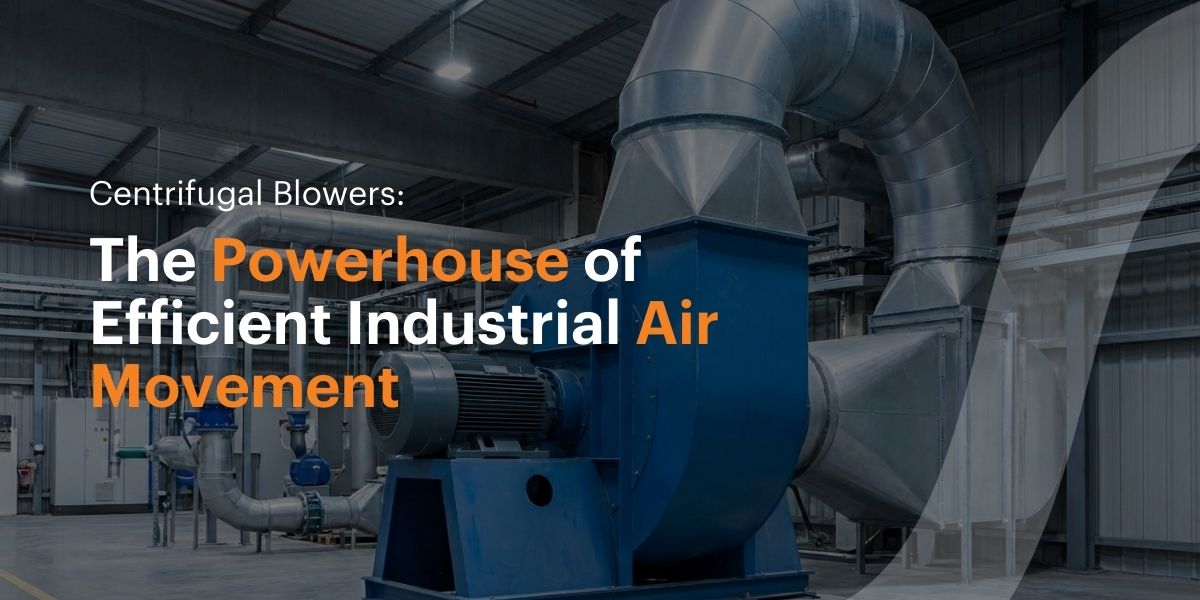
In the intricate systems that power modern industry from ventilating vast factories to aerating wastewater the consistent movement of air is not just a need; it’s a critical process variable. At the heart of these systems lies a workhorse of engineering: the industrial air blower. More than just a fan, a blower is the muscle that pushes or pulls air against significant resistance, making countless processes possible.
For engineers, plant managers, and system designers, selecting the right blower technology is a pivotal decision that affects energy consumption, maintenance costs, and process reliability. While multiple technologies exist, the centrifugal blower stands out for its efficiency, durability, and ability to deliver constant pressure. This guide cuts through the complexity, explaining why centrifugal blowers, like those engineered by Statfield, are the optimal choice for a vast range of demanding industrial applications.
Blower vs. Fan vs. Compressor: Understanding the Key Difference
First, let’s clarify the terminology. While all three machines move air, they are defined by their pressure rise the ratio of discharge pressure to suction pressure.
- Fans handle large volumes of air with a very low pressure rise (less than 1.1). Think ceiling fans or simple exhaust units. They’re for moving air where there’s little system resistance.
- Compressors create a high pressure rise (above 1.2) to significantly reduce air volume, used for powering tools or refrigeration.
- Blowers operate in the crucial middle ground (pressure rise of 1.11 to 1.20). They are designed to move substantial volumes of air against moderate-to-high system resistance, such as pushing air through ductwork, filters, or fluid beds. This is where centrifugal blowers excel.
How a Centrifugal Blower Works: Simple Principle, Sophisticated Engineering
Centrifugal vs. Positive Displacement Blowers: Choosing the Right Tool
| Feature | Centrifugal Blower | Positive Displacement (Roots-type) Blower |
| Operating Principle | Impeller accelerates air; speed creates pressure. | Traps and displaces fixed air volumes with rotating lobes. |
| Flow vs. Pressure | Constant Pressure: Flow varies with system resistance. | Constant Flow: Delivers a fixed volume, pressure varies. |
| Efficiency | High efficiency at or near design point. Efficiency curve is important. | Generally lower full-load efficiency, less sensitive to pressure changes. |
| Pulsation & Noise | Smooth, pulse-free air delivery. Generally quieter operation. | Creates pulsating flow, often requiring silencers. Can be noisier. |
| Maintenance | Fewer wearing parts. Often lower long-term maintenance. | Lobes require precise clearance; can have higher wear in dirty conditions. |
| Ideal Application | Systems requiring steady pressure (aeration, combustion air, drying). | Applications requiring exact volumetric delivery (pneumatic conveying). |
The Statfield Advantage: Engineered for Reliability and Performance
At Statfield, we don’t just supply blowers; we provide engineered air movement solutions. Our centrifugal blowers are built for the relentless demands of industry, with features that ensure long-term value:
- Robust Construction: Designed with heavy-duty materials and precision-balanced impellers for vibration-free operation, minimizing wear and maximizing lifespan.
- Efficiency-Focused Design: Our blowers are engineered to operate at peak efficiency within specified ranges, directly reducing your energy costs and total cost of ownership.
- Application-Specific Engineering: We understand that aeration for wastewater treatment has different needs than fume extraction for chemical processing. We tailor materials, seals, and designs to your specific environment and duty cycle.
- Multi-Stage Capability: For applications requiring higher pressure, our multi-stage centrifugal blowers achieve it incrementally. This is more efficient and reliable than forcing a single stage to excessive speeds, and it’s a key advantage over many positive displacement units for constant-pressure needs.
Key Industrial Applications of Centrifugal Blowers
The versatility of centrifugal blowers makes them indispensable across sectors:
- Water & Wastewater Treatment: For aeration basins, where a constant, reliable supply of oxygen is critical for biological treatment processes. Their pulse-free flow is ideal for diffuser systems.
- Manufacturing & Process Industries: Providing combustion air for boilers and heaters, drying products on conveyor lines, and general plant ventilation.
- Power Generation: Supplying air for combustion and cooling in various power plant systems.
- Pneumatic Conveying: Moving powders and granular materials through pipelines in food, pharmaceutical, and chemical plants, especially where a gentle, consistent air stream is needed.
- Dust & Fume Collection: Powering central collection systems that pull contaminated air through ductwork and filters, requiring blowers that can overcome significant system static pressure.
How to Select the Right Centrifugal Blower: A Practical Guide
Choosing the correct blower is a systematic process. Before you consult with a specialist like Statfield, gather this key information about your application:
- Airflow Requirement (CFM or m³/hr): How much air volume does your process need?
- Pressure Requirement (Static Pressure): What is the resistance the blower must overcome? This includes friction from ducts, filters, fluid head in aeration, etc.
- Gas Composition & Temperature: Is it standard air, hot air, or does it contain moisture, particulates, or corrosive elements?
- Duty Cycle: Will the blower run continuously, intermittently, or with variable demand?
- Site Conditions: Ambient temperature, altitude, and available power supply.
- Noise & Space Constraints: Are there limits on sound levels or physical footprint?
Pro Tip: The operating point on a blower’s performance curve is crucial. A centrifugal blower’s efficiency peaks within a specific range. An experienced partner like Statfield can ensure your selected unit operates in its “sweet spot” for optimal performance and energy savings.
Conclusion: The Strategic Choice for Efficient Air Movement
In the complex equation of industrial operations, efficiency, reliability, and total cost of ownership are paramount. Centrifugal blowers offer a compelling answer, providing a blend of smooth operation, energy efficiency, and robust performance that is unmatched for constant-pressure applications.
For engineers seeking to optimize a process, or plant managers aiming to reduce operational costs, the choice often leads to centrifugal technology. By partnering with an expert like Statfield, you gain more than a piece of equipment you gain a solution engineered for your specific challenge, backed by deep application knowledge and a commitment to performance.
Ready to engineer a more efficient and reliable air system? Contact Statfield’s team of air handling specialists today. Let us analyze your application requirements and recommend the centrifugal blower solution that will deliver performance, durability, and value for years to come.