



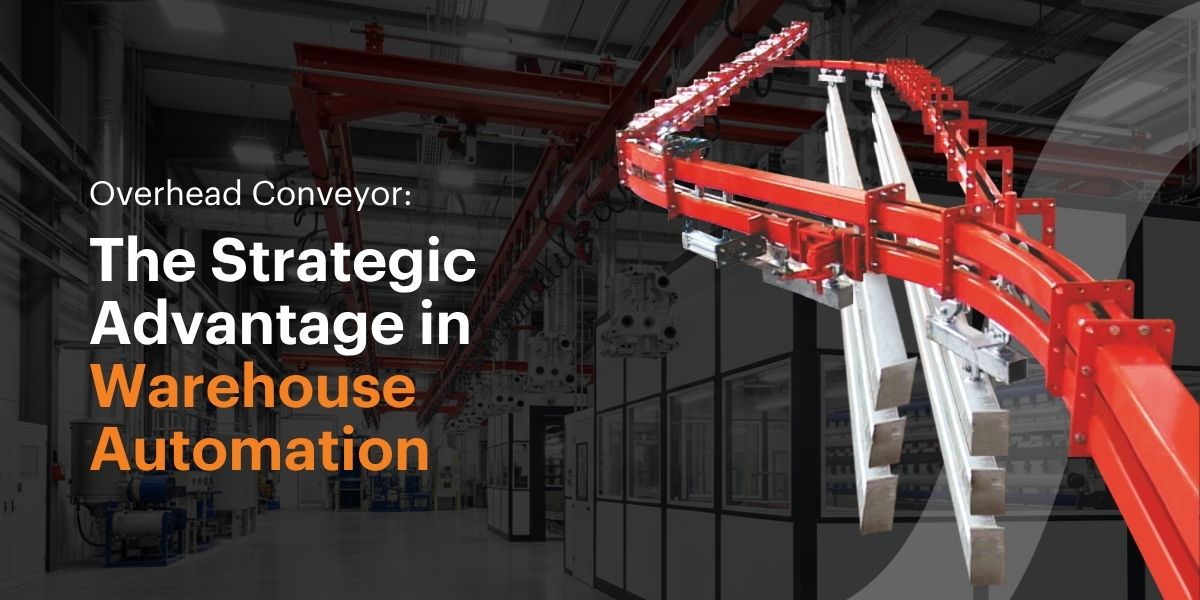
In modern warehouse operations, floor space is a finite and valuable resource. As facilities struggle to balance increasing throughput demands with limited square footage, the most successful operations are looking upward not outward.
Overhead conveyor represent a strategic shift in material handling. By moving products above the workflow rather than across the floor, these systems unlock space, improve ergonomics, and create continuous, predictable material flow that manual transport simply cannot match.
At Statfield, we design and integrate overhead conveyor solutions that don’t just move products they transform operational efficiency. This guide examines the technology, applications, and measurable benefits of overhead conveyor systems, helping you determine whether this approach aligns with your automation strategy.
What Is an Overhead Conveyor?
An overhead conveyor system is a powered material handling solution that transports products, components, or assemblies along an elevated track mounted to a facility’s ceiling or structural framework. Unlike floor-level conveyors that occupy valuable workspace, overhead systems utilize cubic space, keeping aisles clear and workers unencumbered.
These systems range from simple monorail designs for straight-line transport to sophisticated power-and-free configurations that enable accumulation, buffering, and precise routing across complex facility layouts.
Key distinction: Overhead conveyors are not merely “conveyors in the air.” They are engineered systems designed to integrate with upstream and downstream processes, providing controlled movement that supports both high-speed throughput and sequenced production requirements.
Types of Overhead Conveyor Systems
Power-and-Free Conveyors
The most versatile overhead configuration, power-and-free systems use two parallel tracks: a continuous power chain that drives carriers, and a free track where carriers can accumulate independently. This design enables:
- Accumulation without shutting down the power chain
- Precise routing with switches and spurs
- Sequencing to align products with downstream processes
- Load/unload stations at ergonomic heights
Power-and-free systems are ideal for assembly lines, paint finishing, and applications requiring product buffering between processes.
Free Rail
A single-track system where carriers are permanently attached to a moving chain. Free rail conveyors provide continuous, fixed-path transport with lower initial investment than power-and-free systems. They excel in:
- Straight-line transport between processes
- Elevator or mezzanine integration
- Applications where accumulation is not required
Aerorail
Aerorail an enclosed track design protects the chain and reduces maintenance requirements while enabling smooth operation around curves and inclines. This configuration is particularly suited for:
- Clean environments requiring minimal contamination
- Applications with frequent directional changes
- Facilities where maintenance access is limited
Transrail
While technically floor-mounted, inverted systems place the product below the track, providing overhead-style flexibility with easier access for manual operations. These are common in automotive assembly and heavy manufacturing.
Megarail
A specialized overhead conveyor variant where products are transported in suspended pouches or carriers. Pouch sorters provide:
- High-speed sorting and routing
- Gentle product handling for fragile items
- Integrated order fulfillment capabilities
Key Benefits of Overhead Conveyor Systems
1. Maximized Floor Space Utilization
The most immediate and quantifiable benefit of overhead conveyors is space recovery. By moving material transport overhead, you eliminate the need for floor-level conveyor aisles, cart paths, and forklift lanes. This reclaimed space can be repurposed for:
- Additional racking and storage density
- Expanded workstations and picking zones
- Future automation equipment
- Safety buffer zones
For facilities operating at capacity, overhead conveyance often delays or eliminates the need for building expansion.
2. Reduced Labor Costs and Walking
Manual material transport consumes an estimated 30–50% of warehouse labor hours. Workers walking to retrieve items, pushing carts between zones, or waiting for forklifts represent non-value-added time that directly impacts labor costs.
Overhead conveyors deliver products directly to workstations at consistent intervals, allowing workers to remain stationary and focused on value-added tasks. The labor savings typically justify system investment within 12–24 months.
3. Improved Ergonomics and Safety
Musculoskeletal injuries from lifting, pushing, and repetitive motion remain the most common workplace injuries in material handling environments. Overhead conveyors eliminate:
- Manual cart pushing and pulling
- Awkward lifting postures
- Forklift traffic in pedestrian areas
- Product drops and collisions
By delivering items at ergonomic heights and eliminating floor-level transport equipment, overhead systems contribute directly to safety metrics and workers’ compensation cost reduction.
4. Consistent Throughput and Predictable Cycle Times
Manual transport introduces variability. Workers move at different speeds, carts get delayed, and traffic congestion creates unpredictable cycle times. Overhead conveyors operate at consistent speeds, creating predictable material flow that enables:
- Accurate production scheduling
- Reliable customer delivery commitments
- Optimized labor allocation
- Simplified capacity planning
5. Product Protection
Manual transport exposes products to damage from drops, collisions, and rough handling. Overhead conveyors provide controlled movement with minimal product contact, reducing damage rates and associated costs. For high-value or fragile items, this protection alone can justify system investment.
6. Scalability and Modular Expansion
Modern overhead conveyor systems are designed with modular components that allow phased implementation and future expansion. As your business grows, additional track sections, spurs, and accumulation zones can be added without replacing the core system—protecting your capital investment.
7. Real-Time Visibility and Control
Integrated sensors, controls, and software provide real-time tracking of every carrier and product moving through an overhead conveyor system. This visibility enables:
- Dynamic routing based on downstream conditions
- Predictive maintenance alerts
- Throughput monitoring and bottleneck identification
- Accurate inventory location data
Applications Across Industries
- E-Commerce Fulfillment
- Manufacturing and Assembly
- Food and Beverage Processing
- Distribution Centers
- Pharmaceutical and Healthcare
Integration with Warehouse Software
An overhead conveyor system is most effective when integrated with your facility’s software ecosystem. Statfield ensures seamless connectivity between conveyor controls and:
Warehouse Management Systems (WMS) – Provide order-level direction and inventory updates
Warehouse Execution Systems (WES) – Coordinate real-time workflow and resource allocation
Warehouse Control Systems (WCS) – Manage conveyor logic, routing, and equipment coordination
Integrated software enables dynamic decision-making rerouting products based on downstream congestion, prioritizing urgent orders, and providing real-time throughput visibility across your operation.
Design Considerations
When evaluating overhead conveyor systems, several factors influence the optimal configuration:
Product Characteristics
Weight, dimensions, fragility, and handling requirements determine carrier design and track specifications.
Throughput Requirements
Required units per hour, peak periods, and variability drive speed, accumulation capacity, and system redundancy decisions.
Facility Constraints
Ceiling height, structural load capacity, column spacing, and existing equipment placement affect track layout and installation approach.
Integration Points
Upstream processes (receiving, storage) and downstream operations (packing, shipping) define system interfaces and transfer points.
Maintenance Access
Design must accommodate safe maintenance access to drive units, chains, and critical components.
Statfield conducts comprehensive facility assessments and operational analyses to ensure your overhead conveyor system is engineered for your specific requirements—not adapted from a generic template.
Conclusion
Overhead conveyor systems represent a proven approach to material handling that delivers measurable results across industries. By utilizing vertical space, eliminating manual transport, and creating predictable material flow, these systems address the fundamental challenges facing modern warehouses and manufacturing facilities.
At Statfield, we combine engineering expertise with operational understanding to design overhead conveyor solutions that integrate seamlessly with your processes, scale with your business, and deliver sustained competitive advantage.
Whether you are evaluating automation for a new facility or optimizing an existing operation, Statfield provides the guidance, engineering, and support to ensure your conveyor system performs—not just at startup, but for years to come.
Ready to Explore Overhead Conveyor Solutions?
Contact Statfield to schedule a facility assessment or discuss your material handling requirements. Our team will analyze your operation, identify opportunities, and recommend conveyor configurations engineered for your specific needs.
Statfield – Engineered Conveyor Solutions for Automated Operations