



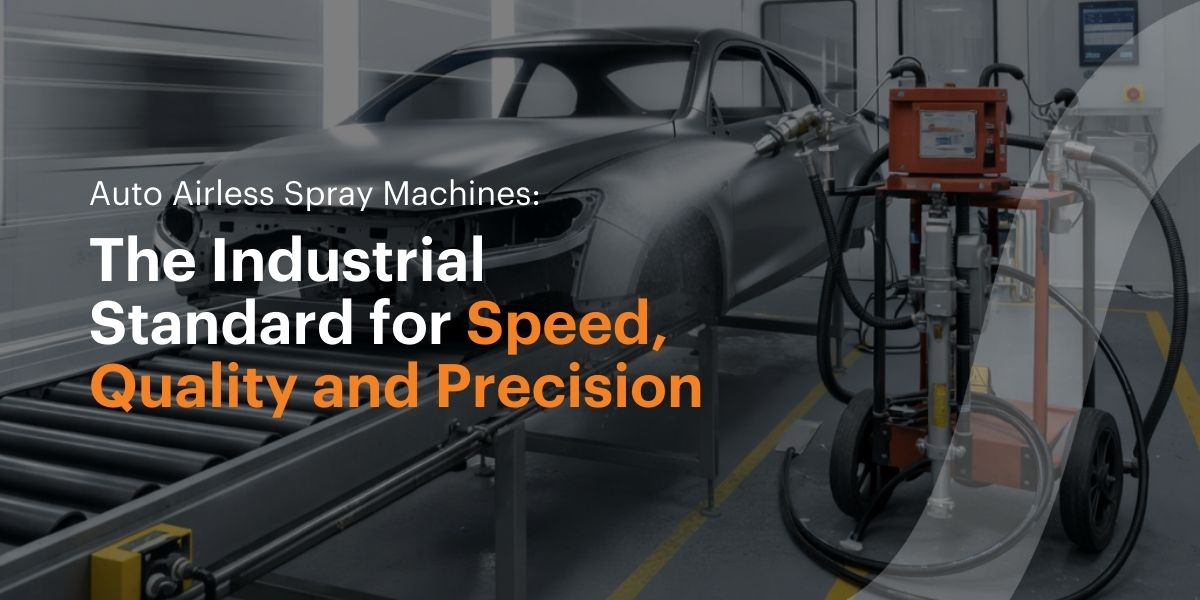
In the industrial manufacturing, finishing isn’t just a final step it’s a critical determinant of product quality, durability and cost. When production volumes are high and consistency is non-negotiable, traditional methods fall short. This is where automated airless spray technology defines the modern standard.
Statfield stands at the forefront of this innovation, providing advanced auto airless spray systems that transform surface finishing from a manual operation into a seamless, high-precision and efficient automated process. By utilizing high-pressure pumps to atomize paint without compressed air, these systems deliver unparalleled uniformity and material efficiency for mass production environments.
Statfield’s auto airless spray machines, demonstrating how they drive productivity and ensure professional-grade results, batch after batch.
1. Core Technology: How Automated Airless Spray Painting Works
Automated airless spray painting represents a significant leap from conventional methods. The process is elegantly efficient:
- High-Pressure Atomization: Instead of using compressed air to break apart the material, a powerful pump pressurizes the paint or coating to extremely high levels (often exceeding 250 bar). This pressurized fluid is then forced through a precisely engineered small opening (the spray tip) in the automated gun.
- Automated Application: In a typical Statfield system, parts are conveyed on a moving line through enclosed spray booths. Here, the paint is applied by automated spray machines mounted on robotic arms or reciprocators. This ensures every square inch of the surface receives a consistent, pre-programmed application.
- The Resulting Advantage: This method creates a fine, even mist that provides superior transfer efficiency. It minimizes overspray, ensures uniform film thickness, and drastically reduces paint waste compared to manual or air-assisted automated spraying.
2. Key Advantages for Industrial Operations
Integrating an auto airless spray system from Statfield delivers measurable benefits that impact the bottom line:
- Unmatched Speed & Throughput: Automated systems operate continuously and at high speed, significantly accelerating production cycles and boosting overall output.
- Consistent, High-Quality Finishes: Programmed robotic paths eliminate human variability. Every part receives an identical application, ensuring consistent color, texture, and coating thickness, which enhances product quality and reduces reject rates.
- Exceptional Material Efficiency: The high transfer efficiency of airless technology, combined with automated precision, leads to direct reductions in paint consumption and material costs. There is minimal overspray waste.
- Optimized Labor Deployment: Automating the spraying process reallocates skilled labor from repetitive, hazardous spraying tasks to more valuable roles in supervision, quality control, and maintenance.
- Improved Workplace Safety: Automated systems isolate operators from direct exposure to paints, solvents, and fumes, creating a safer and more compliant working environment.
3. Featured Statfield Systems: Precision Engineered for Your Industry
Statfield’s expertise is showcased in two distinct, high-performance systems designed for specific industrial challenges.
A. The Auto Airless Spray Machine for Mass Production
This system is the workhorse for high-volume manufacturing, ideal for automotive components, metal fabrication, appliance manufacturing, and any scenario where paint consumption is high and consistency is key.
Technical & Operational Highlights:
- High-Pressure Pump System: Designed to handle high-viscosity materials and maintain consistent pressure for uniform atomization across long production runs.
Multi-Gun Reciprocator Setups: Multiple spray guns can be mounted on automated reciprocators, allowing for simultaneous, synchronized coverage of large parts or high-throughput processing of smaller items.
Seamless Conveyor Integration: Engineered to integrate directly with existing overhead or floor conveyor systems for a continuous flow production line.
Centralized Control & Monitoring: Modern PLC controls allow operators to monitor pressure, fluid flow and system status, and make adjustments for different parts or colors.
B. UNISPRAY: The Specialized Fiber Finishing System
Developed in collaboration with various industry leaders, UNISPRAY is a testament to Statfield’s capability in creating niche, revolutionary solutions. It is a unique airless application system designed specifically for applying antistatic and other functional finishes to polyester staple fiber, viscose and blends in the textile industry.
Why UNISPRAY is a Game-Changer for Textiles:
| Traditional Dipping/Bath Methods | Statfield UNISPRAY System |
| Non-uniform finish application, leading to inconsistent fiber properties. | Uniform and measured spray ensures exceptional, even fiber coverage. |
| High wastage of expensive finishes; excess liquid must be squeezed out. | Fully automatic, zero-waste process with no over-spray or run-off. |
| Fibers become wet, causing downstream processing issues in spinning. | No fiber wetting, ensuring trouble-free carding, drawing, and spinning. |
| Large tanks and storage spaces for finish liquids are required. | Reduces space and inventory needs for finishing agents. |
| Variable quality in the final blended yarn due to inconsistent finish. | Significantly improves ultimate yarn quality through steadier, controlled application. |
4. Critical Applications Across Sectors
Statfield’s auto airless technology is versatile and scalable, making it indispensable across a broad industrial spectrum:
- Automotive & Transportation: Primer and top-coat application on parts, chassis, and components.
- Metal Furniture & Fixtures: Coating for office furniture, lockers, and industrial shelving.
- Appliance Manufacturing: Enamel and paint application on washing machines, refrigerators, and panels.
- Textile Manufacturing (UNISPRAY): Precision application of antistatic, softening, or antimicrobial finishes directly onto fiber blends before spinning.
- General Industrial Manufacturing: Any process requiring a durable, consistent protective or decorative coating on metal, wood, or composite substrates.
5. Choosing the Right Partner: Why Statfield?
Investing in an automated finishing line is a major decision. Statfield differentiates itself through:
- Application-Specific Engineering: We don’t just sell machines; we provide solutions tailored to your specific material, part geometry, and production goal.
- Proven Collaboration: Our development of UNISPRAY with industry leaders proves our commitment to solving unique, complex challenges through direct partnership.
- End-to-End Support: From initial design and integration to installation, training, and ongoing maintenance, Statfield provides comprehensive support to ensure your system delivers peak performance.
Conclusion
In the pursuit of manufacturing excellence, the finishing process cannot be an afterthought. Statfield’s auto airless spray machines provide the technological bridge to achieve superior quality, operational efficiency, and cost control. By automating the most critical and variable step in coating application, you secure a predictable, high-quality finish that protects your product and enhances your brand.
Whether you are coating industrial components or finishing textile fibers, Statfield has the engineered solution to elevate your process.
Ready to transform your industrial finishing operation? Contact Statfield today to schedule a consultation with our engineering team. Let us analyze your application and demonstrate how our automated airless spray technology can optimize your productivity, quality, and profitability.