



In industrial environments, moving air is not a luxury it is a necessity. Whether you are ventilating a manufacturing facility, conveying materials through pneumatic systems, or maintaining precise combustion conditions, the equipment you choose determines efficiency, reliability, and operating costs.
Centrifugal blowers stand apart from other air-moving devices. Unlike axial fans that move air parallel to the blade axis, centrifugal blowers generate higher pressure with consistent airflow, making them indispensable for applications that demand force, direction, and durability.
At Statfield, we design and manufacture industrial centrifugal blowers engineered for the most demanding environments. With a comprehensive range covering airflow from 1,000 CMH to 300,000 CMH and pressure up to 1,500 MMWC, our solutions serve industries across India and global markets. This guide explores centrifugal blower technology, selection considerations and how Statfield’s expertise delivers reliable, energy-efficient performance tailored to your application.
What Is a Centrifugal Blower?
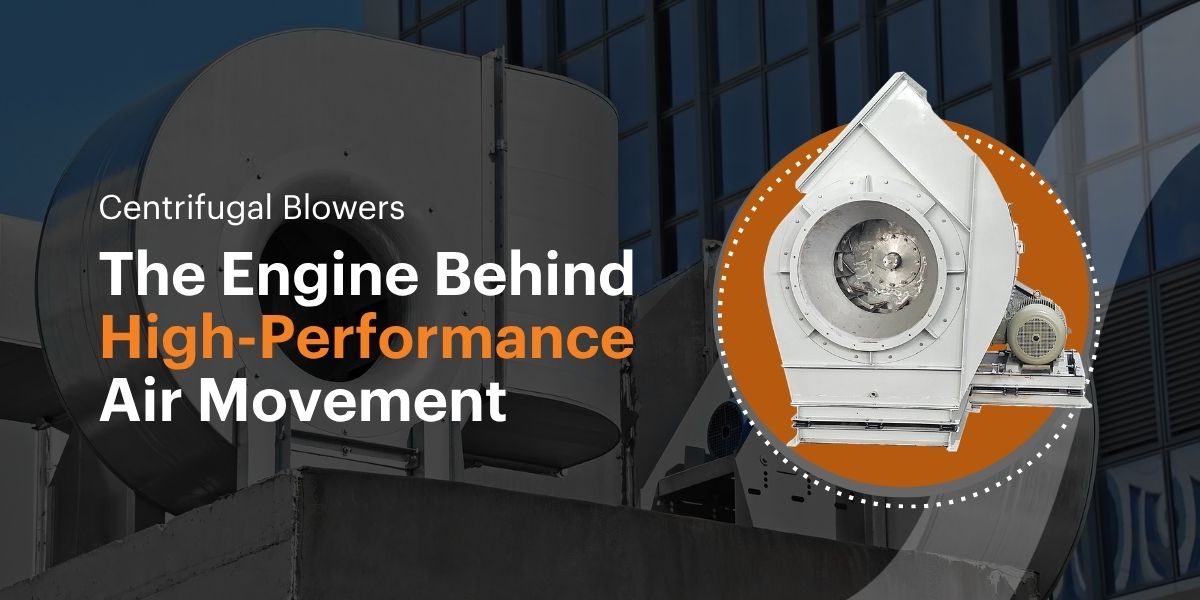
A centrifugal blower often called a centrifugal fan operates on a simple yet powerful principle: air enters the impeller axially (parallel to the drive shaft), is accelerated by rotating blades, and is discharged radially (perpendicular to the shaft) through a scroll housing. This 90‑degree change in direction converts rotational energy into static pressure, enabling the blower to overcome system resistance and move air through ducts, filters, and process equipment.
Key components include:
- Impeller – The rotating element with
- backward-curved, forward-curved, or radial blades that determines pressure and flow characteristics.
- Housing – A spiral casing that collects discharged air and directs it to the outlet.
- Drive arrangement – Direct drive, belt drive, or coupling drive, influencing speed control and maintenance.
The result is a robust machine capable of delivering high pressure at stable flow rates—ideal for industrial processes where axial fans fall short.
Statfield Centrifugal Blower Range
Overall Performance Envelope
| Parameter | Statfield Range |
| Flow Rate | 1,000 CMH to 300,000 CMH |
| Pressure | 10 MMWC to 1,500 MMWC |
| Power | 0.5 HP to 500 HP |
| Drive Arrangements | Direct Drive, Belt Drive, Coupling Driven |
| Fan Types | SWSI, DWDI, Plug Fans |
Drive Configurations – Choosing the Right Fit
Flange‑Mounted Direct Driven
- Speed: 1,400 – 3,000 RPM
- Flow: 500 – 35,000 CMH
- Pressure: 45 – 850 mm WC
- Power: 0.5 – 40 HP
- Temperature: Up to 80°C
- Impeller: Backward Curved / Inclined
Ideal for compact installations where space is limited and the blower mounts directly onto equipment or ductwork.
Foot‑Mounted Direct Driven
- Speed: 1,400 – 3,000 RPM
- Flow: 500 – 35,000 CMH
- Pressure: 45 – 850 mm WC
- Power: 0.5 – 40 HP
- Temperature: Up to 80°C
- Impeller: Backward Curved / Inclined
A versatile floor‑standing configuration that simplifies installation and maintenance in industrial settings.
Flange‑cum‑Foot Direct Driven
- Speed: 1,400 – 3,000 RPM
- Flow: 500 – 35,000 CMH
- Pressure: 45 – 850 mm WC
- Power: 0.5 – 60 HP
- Temperature: Up to 80°C
- Impeller: Backward Curved / Inclined
Combines mounting flexibility can be flange‑attached or foot‑mounted—allowing adaptation to varying site requirements.
Belt Driven Blower
- Speed: 1,400 – 3,200 RPM
- Flow: 500 – 225,000 CMH
- Pressure: 45 – 1,150 mm WC
- Power: 0.5 – 200 HP
- Temperature: Up to 350°C
- Impeller: Backward Curved / Inclined
Belt drive enables speed adjustment through pulley selection and isolates the motor from elevated temperatures. The preferred choice for high‑temperature applications and when system resistance varies.
Coupling Driven Blower
- Speed: 1,400 – 3,200 RPM
- Flow: 500 – 225,000 CMH
- Pressure: 45 – 1,150 mm WC
- Power: 0.5 – 200 HP
- Temperature: Up to 350°C
- Impeller: Backward Curved / Inclined
Provides direct power transmission with minimal energy loss, suitable for continuous operation in heavy‑duty industrial processes.
Fan Types: SWSI, DWDI and Plug Fans
Statfield manufactures three primary centrifugal fan configurations:
Single Width Single Inlet (SWSI)
Air enters from one side of the impeller. These fans are compact, cost‑effective, and widely used for general industrial ventilation, dust collection, and drying applications.
Double Width Double Inlet (DWDI)
Air enters from both sides of a wider impeller, delivering higher flow rates within a relatively compact footprint. DWDI fans excel in large‑volume air handling systems, HVAC, and process cooling.
Plug Fans
Housing‑less centrifugal fans designed for direct integration into air handling units or custom enclosures. They offer space savings and simplified installation, particularly in OEM equipment and modular systems.
Key Benefits of Statfield Centrifugal Blowers
1. Energy Efficiency Optimized
Backward‑curved impeller designs maximize aerodynamic efficiency, reducing power consumption compared to forward‑curved or radial alternatives. Lower energy use translates directly to reduced operating costs over the equipment’s lifecycle.
2. High Pressure Capability
Centrifugal blowers excel where pressure is critical—pneumatic conveying, combustion air, or overcoming restrictive duct networks. Statfield units achieve pressures up to 1,500 mm WC, handling even the most challenging system resistances.
3. Temperature Tolerance
Belt‑driven and coupling‑driven configurations isolate the motor from high‑temperature air streams, allowing continuous operation at media temperatures up to 350°C. Direct‑drive units are rated for standard temperatures up to 80°C.
4. Robust Construction
Built from heavy‑gauge steel with precision‑balanced impellers, Statfield blowers withstand continuous operation in harsh industrial environments. Options include corrosion‑resistant coatings and stainless steel construction for aggressive applications.
5. Flexible Drive Arrangements
With three distinct drive options—direct, belt, and coupling—you can select the configuration that best matches your speed requirements, space constraints, and maintenance preferences.
6. Custom Engineering
No two industrial processes are identical. Statfield provides custom modifications including:
- Inlet and outlet flanges to match existing ductwork
- Special coatings for chemical resistance
- Explosion‑proof motors for hazardous locations
- Variable frequency drive (VFD) integration for precise speed control
How to Select the Right Centrifugal Blower
Choosing the optimal blower involves more than matching specifications on a datasheet. Statfield engineers consider:
1. Airflow (CMH) – The volume of air required at operating conditions.
2. Static Pressure (mm WC) – Total resistance of the system, including ducts, filters, dampers, and process equipment.
3. Temperature – Media temperature determines material selection and drive arrangement.
4. Mounting Space – Direct‑drive units are compact; belt‑drive allows motor placement away from heat.
5. Duty Cycle – Continuous vs. intermittent operation influences bearing selection and motor sizing.
6. Environmental Factors – Dust, moisture, corrosive gases, and hazardous areas dictate construction materials and certifications.
Our technical team performs system analysis to recommend the most efficient and durable configuration, ensuring you do not oversize or undersize the equipment.
Why Statfield?
With decades of experience in industrial air movement, Statfield combines engineering depth with manufacturing precision. We do not simply supply equipment—we partner with you to understand your process, optimize performance, and ensure long‑term reliability.
- In‑house engineering – Custom designs, performance calculations, and 3D modeling.
- Quality manufacturing – Rigorous testing, balancing, and inspection before dispatch.
- Nationwide support – Installation guidance, commissioning, and after‑sales service.
- Commitment to efficiency – Every blower is selected or designed to minimize energy consumption while meeting process demands.
Conclusion
Centrifugal blowers are the workhorses of industrial air movement, delivering the pressure and reliability that axial fans cannot match. Whether you need a compact direct‑drive unit for localized drying or a high‑capacity belt‑driven blower for a 300,000 CMH dust collection system, Statfield provides solutions engineered for performance, durability, and efficiency.
Our range spans from 0.5 HP to 500 HP, with configurations to suit any installation, temperature, or duty cycle. Backed by technical expertise and a commitment to quality, Statfield is your trusted partner in industrial air handling.
Ready to Optimize Your Air Movement?
Contact Statfield today to discuss your application. Our engineers will analyze your requirements, recommend the ideal centrifugal blower configuration, and provide a comprehensive solution tailored to your facility.
Statfield – Engineered Air Movement Solutions