



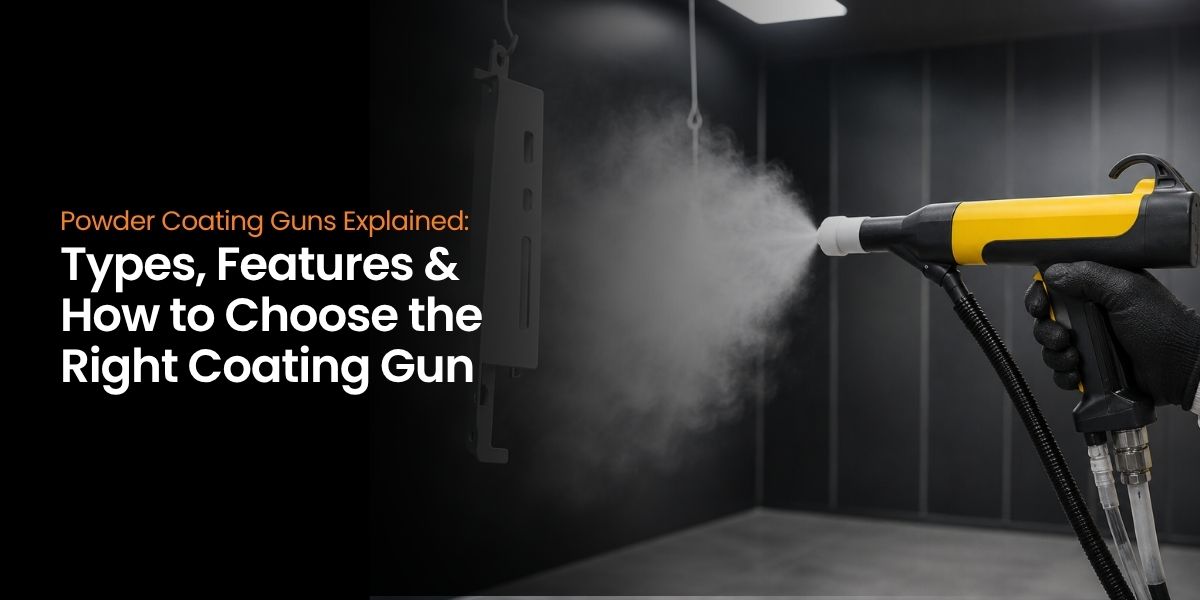
A buyer’s guide for shop floors deciding between manual, automatic and electrostatic coating guns
The coating gun is the one piece of equipment on a powder line that every finished part passes through. Get the wrong one and you inherit uneven coverage, wasted powder, and rework, no matter how good the oven or booth is. Here is what actually separates one gun from another.
Manual vs. automatic guns
A manual coating gun puts an operator in control of every pass, useful for low-volume runs, prototypes, and parts with tricky geometry that a fixed spray pattern cannot reach. An automatic gun, mounted on a reciprocator or fixed at a booth station, holds a consistent pattern run after run, which is what high-volume lines need to keep coating thickness within spec.
Most shops running both short custom jobs and repeat production end up with a mix of both, rather than standardizing on one.
How electrostatic charging fits in
Nearly every powder coating gun today works on the same principle: charge the powder particles as they leave the nozzle so they are drawn to the grounded part instead of drifting past it. This is what gives powder coating its high transfer efficiency compared with liquid spraying. We cover the charging process itself, corona versus tribo charging, in more detail in our equipment guide.
Features worth checking before you buy
Voltage control: Adjustable kV output lets you tune penetration for recessed areas without overspray on flat surfaces.
Nozzle types: Flat spray, round pattern, and deflector nozzles each suit different part shapes; a gun that swaps nozzles quickly saves changeover time.
Hopper capacity and feed consistency: A feed hopper that clogs or pulses under low powder levels shows up directly as streaking on the part.
Cleaning time between colour changes: On mixed-colour lines, this often matters more than the spec sheet’s coverage numbers.
A short checklist before you order
1. What is your part volume, and does it justify an automatic gun over a manual one?
2. How often do you change colours or powder types?
3. Do your part shapes include recesses, edges, or Faraday cage areas that need specific voltage control?
4. Who services the gun locally if a part fails?
The right coating gun is the one matched to your part mix and volume, not the one with the highest voltage rating on paper.