



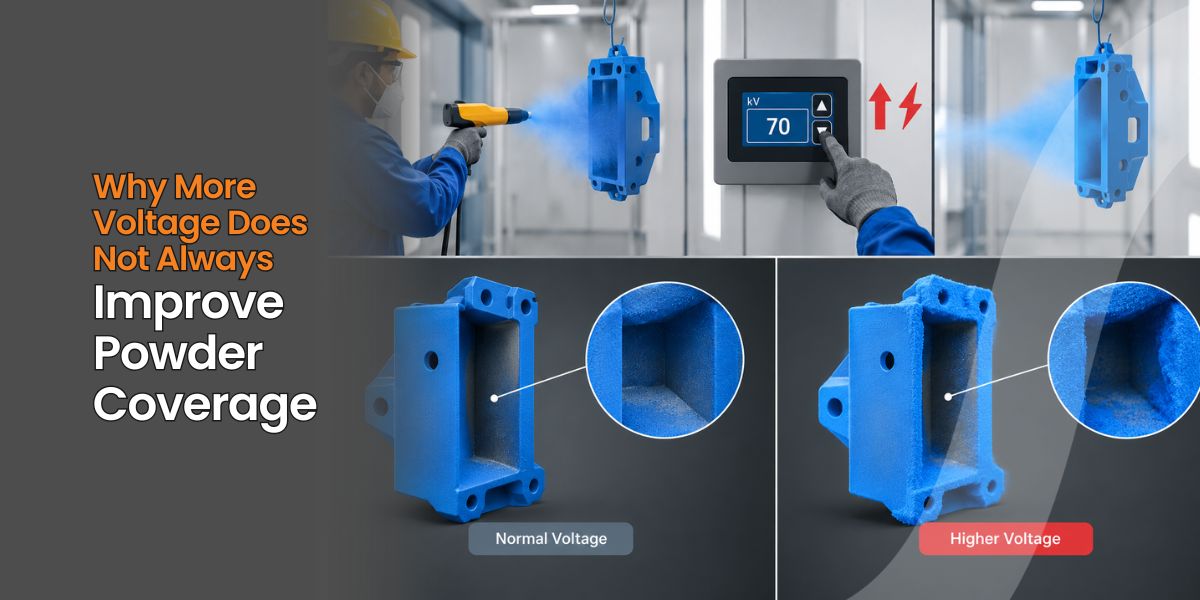
In powder coating, operators may increase the voltage when powder does not reach corners, channels or deep recesses. It appears to be a simple solution: more voltage should attract more powder.
But component geometry can change how the charged powder behaves. Increasing the setting may cause more powder to collect around the edges while the recessed area remains lightly coated.
Why Do Recessed Areas Remain Uncoated?
During electrostatic powder coating, charged powder particles move towards an earthed component. On open and flat surfaces, this process is generally more direct.
Inside corners and cavities are different. The electrical field can become stronger around the outer edges, making it difficult for powder to enter the deeper area. This condition is commonly known as the Faraday cage effect.
The problem is therefore not always insufficient voltage. It may be the way the component’s shape influences powder movement.
What Happens When Voltage Is Increased?
Higher powder coating voltage can strengthen the electrical field around the component’s outer edges. More powder may then build up on surfaces that are already receiving enough coverage.
At the same time, the deep corner may continue to receive less powder. Excessive charging can also make the application more difficult to control.
This is why adjusting voltage without observing the complete coating pattern may not solve the original problem.
Review More Than One Setting
Effective corner coverage depends on several connected factors. Powder flow, gun distance, spray angle, nozzle selection and component earthing can all influence the result.
The powder coating gun may need to approach the recess from a different angle or distance. The operator may also need to reduce the powder output or adjust the voltage to help powder enter the difficult area.
For automated applications, gun positioning and movement should be planned around the actual component geometry—not only its overall dimensions.
Change One Variable at a Time
Changing voltage, powder flow and gun distance together makes it difficult to understand which adjustment improved the result.
Start with one setting. Coat a test component. Inspect the flat surfaces, edges and recesses. Record the result before making the next change.
This simple method supports more effective use of powder coating equipment and helps operators create repeatable settings for similar components.
Set the Equipment Around the Component
There is no single powder coating gun setting that works for every shape. Flat panels, tubes, boxes and components with deep cavities may each require a different application approach.
Understanding the component first makes it easier to select the right voltage, powder flow, gun distance and spray pattern.
More voltage does not always mean better coverage. The right setting begins with the component.
Share your component geometry and coating challenge with Statfield.
